
2024: A Record Year for REMIT Enforcement
Introduction
Enforcement cases in 2024 – a retrospective
In February the Romanian National Regulatory Authority, ANRE, got the ball rolling by fining four firms a total of RON537,503,319 (roughly EUR 108 million) for breaching Article 5 of REMIT for alleged A-B-A type wash trading on the OPCOM-operated Centralised Market for bilateral electricity contracts (see here). A single firm was fined an astonishing EUR 73million (approximately), the largest single enforcement fine under REMIT since its inception. The other three entities were fined EUR 20 million, EUR 10 million and EUR 4,5 million respectively. All of the companies involved have lodged appeals against the fines which, to many observers, seem ill-founded and overzealous by the regulator concerned.
Also in February, the Italian National Regulatory Authority, ARERA, issued a EUR 940,000 fine to a Swiss gas trader for an alleged breach of Article 5 of REMIT in the Italian gas market (see here). The case relates to physical storage and an apparent misunderstanding of the market rules by the firm involved resulting in significant system imbalance requiring the system operator to step in. The case invoked the rarely used provision that “fictitious devices” were used to manipulate the market as defined under Article 2 of REMIT.
In March ARERA fined another Swiss company EUR 25,000 for failing to register and report transactions as required by the provisions of Articles 8 and 9 of REMIT (see here).
In April, ANRE followed up on their February enforcement actions by announcing a further three REMIT fines (see here) with penalties totalling RON 18,005,844 (roughly EUR 3.6million). These fines were for alleged pre-arranged trading on the OPCOM Centralised Market for bilateral electricity contracts in breach of Article 5 of REMIT. Two of the fines exceeded EUR 1million. Like the record-setting fines for alleged wash trading in February, the instances of abuse appear relatively small with only four trades being involved. ACER claims to have originally detected the suspicious behaviour before notifying OPCOM who, in turn, notified ANRE.
Also in April, the National Regulatory Authority for Bulgaria, EWRC, announced a fine against Kozloduy NPP, a large Bulgarian nuclear generator, for insider trading in the Bulgarian intraday and day ahead power markets in breach of Article 3 of REMIT (see here). The breach occurred over two days in October and November 2021. The generator was fined BGN 604,064 (roughly EUR 308,000) although very few additional details are provided.
In a second case announced in May, EWRC fined a generator BGN 10,000 (roughly EUR 5,000) for failing to disclose inside information in breach of Article 4 of REMIT (see here). As for the first EWRC case above, the announcement provides very little detail but the breach apparently occurred in October 2023.
In June the German National Regulatory Authority, Bundesnetzagentur, fined one of the German natural gas network TSOs EUR 75,000 for failing to disclose inside information in breach of Article 4 of REMIT (see here) when performing commissioning tests on the Nord Stream 2 gas pipeline in 2021.
In July the Spanish National Regulatory Authority, CNMC, issued a EUR 1 million fine to a Spanish utility for the manipulation of the closing price of the D+1 product in the MIBGAS gas market (see here). The “marking the close” activity was determined to have breached Article 5 of REMIT. In September the CNMC followed up with another fine in the Spanish short term power market where a technology-based route to market provider was fined EUR 1.08 million for allegedly manipulating prices by issuing and withdrawing non-genuine orders from the market (see here). The company acted as an agent on behalf of 34 other market participants and traded in the market on behalf of these firms using their market access credentials. The CNMC accused the other firms of coordinating their activities to manipulate the market (to which most pleaded ignorance). These firms were not fined.
Jumping to what turned out to be a busy December when the EWRC issued four separate fines involving three local power generators and the TSO for various breaches under REMIT and local laws (see here). This included inside information disclosure failings in breach of Article 4 of REMIT, failing to accurately register with ACER in breach of Article 9 of REMIT, and other failures under local laws. The total fines issued were comparatively modest amounting to BGN 117,000 in total (approximately EUR 60,000). The TSO appears to have been fined for not reflecting the correct information on its chosen transparency platform in the EU’s CERMEP register.
To end the year, it was again the turn of the CNMC who issued two fines totalling EUR 7.5 million for the alleged manipulation of the Spanish short term power market (see here and here). The firms were accused of quote stuffing in the Spanish intraday continuous power market where large numbers of orders were sent to the trading platform, either before the relevant product was open for trading, or were in excess of the maximum order message permitted by the exchange. The activity aimed to put their orders first in line for lucrative cross-border traders with France by preventing other market participants’ orders from reaching the market. The order rate restriction was put in place to help OMIE’S trading platform handle increasing trading activity, most likely caused by an increase in algorithmic trading across the market. Due to the high likelihood that many of these orders would be rejected, OMIE and the CNMC saw them as non-genuine, thereby breaching Article 5 of REMIT.
As a postscript, in December the Norwegian energy regulator, NVE-RME, fined a Danish trading company for failing to notify the market regarding substantial erroneous trades made in the Norwegian power market and for subsequently trading on inside information aimed at correcting the trading errors (see here). As Norway is a member of the European Economic Area (EEA) and not the EU, REMIT rules apply via local statutes, explaining why this fine is not mentioned on ACER’s enforcement page.
Looking ahead
As the age old disclaimer goes, past performance is no guarantee of future returns. While 2024 was a significant year from a REMIT enforcement perspective, there is of course no guarantee this will continue in an upward trend. However, most published REMIT enforcement cases have a lag of several years. That is, the infringement(s) usually occurred a year or more before the announcement of the enforcement action. As such, the vast majority of the enforcement cases in 2024 fell under the REMIT 1 regime. There are many reasons to expect an increase in enforcement under REMIT 2, both in 2025 and beyond.
The first is driven by the increasing demands set by REMIT 2 for both Persons Professionally Arranging Transactions (PPATs) and Persons Professionally Executing Transactions (PPETs) to report suspicious transactions to NRAs and ACER.
The second is the increase in scope of activities falling under REMIT 2, and the expectation that such activities are actively monitored by PPATs, PPETs and Direct Electronic Access providers. Auction, capacity and balancing markets, as well as the publication of inside information, will all become subject to more active monitoring. This will almost certainly lead to an uptick in enforcement.
The third is the new powers given to ACER under REMIT 2 empowering it to initiate and conduct investigations in its own right when cross-border activities are involved. It’s likely that a significant number of cases involving cross-border trading go unnoticed (and unpunished), particularly in European short-term power markets. For example, ACER has warned market participants about cross border wash trades in the past [2], as have other stakeholders such as the Nord Pool exchange [3]. Enforcement in these areas are virtually certain to increase.
The final consideration relates to the growth in capabilities of the regulators themselves, including ACER. In its recently published Multi-Annual Work Programme [4], ACER outlined reasonably significant additional spend on surveillance, including the bespoke development of new detection tools to address the many deficiencies of their existing surveillance solution. Complimented by a new in-house Investigations Department, ACER will no doubt trigger many more investigations of their own volition. Many national regulators are also seeking to beef up their monitoring capabilities.
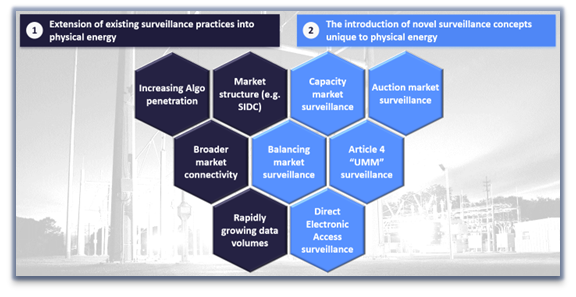
The above developments carry several challenges for market participants, with Article 15(2) of REMIT 2 now requiring that many firms monitor their physical power and gas trading activity. ACER’s position, as recently confirmed in their updated REMIT Guidance [5], requires that firms with existing surveillance obligations under the financial Market Abuse Regulation (MAR), should extend such capabilities to their physical market trading. This mantra, designed presumably to reduce the monitoring burden placed on pure physical players, seems straightforward enough on paper. In practice however this, as illustrated in the diagram below, introduces many novel areas of surveillance typically not addressed by most off-the-shelf surveillance solutions available in the market. Market participants and surveillance vendors have their work cut out for them in plugging these gaps.
Conclusion
2024 was a record-setting year for REMIT enforcement. While we can’t predict the future, it is possible that this trend will continue in 2025 and beyond, perhaps with the emergence of enforcement actions originating from ACER itself. From a transaction surveillance perspective, market participants are advised to determine whether they fall into scope of the Article 15(2) requirements of REMIT 2 (this blog may be of help in this regard). Those firms in scope are advised to determine how best to approach the monitoring of complex short-term markets under SIDC/XBID, including venues such as EPEX Spot and Nord Pool. They should also have a strategy for addressing the novel surveillance requirements under REMIT 2 which may include capacity and balancing markets, auctions and the publication of Urgent Market Messages (UMMs) – the latter now being an explicit surveillance area in its own right. With a lag in time from infringement to enforcement – the sooner you are able to detect suspicious activity in each of these areas, the better.
1Seventeen if you count a case from CRE, the French regulator, which was tossed out on appeal and 18 if you consider “REMIT-equivalent” cases from the European Economic Area (EEA) countries.
2https://www.acer.europa.eu/sites/default/files/REMIT/REMIT%20Reports%20and%20Recommendations/REMIT%20Quarterly/REMITQuarterly_Q1_2023_1.0.pdf
3https://www.nordpoolgroup.com/4ac6c4/globalassets/download-center/market-surveillance/ms-newsletter-q3-2023.pdf
4https://www.acer.europa.eu/news-and-events/news/acer-publishes-its-multi-annual-work-programme-2025-2027
5https://www.acer.europa.eu/sites/default/files/documents/Other%20Documents/6.1st_Edition_ACER_Guidance.pdf